
Publications
8 min read
Why early patient input to medicines’ research and co-creation of target value profile are the critical success factors for future assets?
Over my 25-years career within the industry I had a pleasure to prepare and facilitate the 6 global patient advisory boards to inform early medicines research and develop patient-driven target value profile (TVP). Taking the popularity of patient advisory board as pretty standard advice-seeking or insights gathering activity explored by medical, R&D and other functions, this number may not seem impressive, however, the discussion focus on early stages and its potential impact on asset development strategy cannot be underestimated. I have covered this aspect in the recent LinkedIn Post on how patient experience data can inform the 5 strategies across the asset lifecycle.
Well, many colleagues may say that subject of such discussions have not been defined in detail yet and most of industry professionals have not necessary capabilities to organise and conduct such advisory activities. Moreover, senior leadership may not see the value of the earlier patient input and therefore its impact on “go-go”/”no-go” decision making. These doubts to some extent have been supported the express surveys done the Medical Affairs Professional Society (MAPS) former Patient Centricity Focus Area Working Group during the webinars and workshops with MAPS members: medical affairs professionals had been rarely involved in, supported or organized patient advisory boards on early research development having no/little experience on this matter and related skills. At the same time, more than 80% of MAPS respondents could see the value of such activities and would like to be upskilled, then involved much more.
Another challenge is coming with the substantiation and proof of value: alongside sharing good practices and assumptions, there have been no publications nor any modelling on the long-term impact of early patient engagement and TVP discussions on an asset’s success (we do remember the great paper published in 2018 “Measuring the Impact of Patient Engagement and Patient Centricity in Clinical Research and Development” focusing on the clinical development stages). Notably, measuring the impact of patient engagement within early research and TVP development as well as long-term estimation/prediction models are being left behind the common and well-known initiatives aimed to define success and measure an impact of patient engagement.
Without any doubts about the common approach and cross-sectoral efforts to measure success/impact of patient engagement activities, I do believe we still cannot recognize the “elephant in the room” – well-defined, patient-driven TVP could be a game changer throughout the whole asset development continuum as well as powerful driver of any asset development strategy. The key questions are: WHEN we start the partnership with patient communities and WHAT are we going to discuss with them? Those questions have already been addressed in the format of “How to” guide by PFMD , and as a contributor to this project, I would like to highlight some important aspects and share the practical examples driven by my experience earlier.
First, WHEN to start? The answer is simple: as early as possible, ideally when the research team starts working on the target identification and developing an overall asset concept. Target might be relevant for more than one condition/disease area, or group of conditions; that’s why the characterisation of condition-focused patient community or patient experts might be challenging, if not possible. Research team may want to understand the common patient experience with the dedicated symptoms/manifestations or syndrome (for example, pain, itch, spasticity, anxiety, jaundice etc.) typical for several medical conditions, rather than with a condition itself. On the other hand, the assays/targets might be common for several diseases, for example inhibition of tyrosine kinase or BRAF for several neoplasms. How to identify key patient experts and compose the patient advisory panel in such cases? There are a couple of good practices: to invite members of umbrella patient organization or advocacy group, or to compose the panel with representatives of different disease-focused organizations. Sometimes patient community is not organised in the format of patient organization or advocacy group (for example, for many rare or ultra-rare conditions), so patient community might be represented by families, group of caregivers/parents, or separate advocates/activists (predominantly in social media); this should be taken into consideration. If a disease area is still indefinite or very general (like haemablastoses, solid tumours, inflammation, autoimmune process, neurodegenerative disorders etc) – the advice is to consider R&D-trained patient experts or advocates (for example, EUPATI , Patvocates or research activists).
To build long-term, trusted relationships from the start, it’s important to set “round table” co-creation partnership rules avoiding ad hoc or “on demand” approach as much as possible. There has been the constructive criticism articulated by well-known patient advocates and patient community leaders that engagement has rather occasional nature when it’s needed from the industry/sponsor perspective, without any follow-up communication on the impact and decisions made. This doesn’t add a trust and cannot contribute to a real partnership. Patient experts should feel the value of their involvement in asset development, continuous input and exchange on TVP attributes.
Next, WHAT to discuss? First and foremost, experience living with a condition or conditions (if they have been defined). Research team may explore the highly heterogenous patient experience data (PED) and available evidence, however it should be discussed and validated by patient experts, especially when team is moving forward with identification of unmet patient/medical needs, service gaps and treatment expectations. For instance, people living with post-stroke spasticity highlighted the importance to manage not just muscle stiffness, but also the pain. Or people living with auto-immune rheumatoid condition may prioritise the target group of joints to be managed first in terms of daily life and functioning: walking, fine hand movements/writing, temporo-mandibular joint for eating and articulation etc. These aspects should be discussed to inform the research strategy and key directions, when hypotheses/assumptions could either be confirmed or rejected/revised. Categorization of patient experience (e.g. medical/treatment related, emotional/cognitive, social, role-specific and functional, infrastructure related, caregiver’s experience) and mapping this PED and insights throughout a pathway or generic patient journey – MUST exercise at this stage which can inform the patient-driven TVP development.
It’s important to ensure good understanding the difference between TVP and TPP (Target Product Profile) and discuss an incremental value to be delivered by an innovative technology/medicine in comparison with existing standards of care, if such exist. TPP defines the set of the expected asset/product characteristics, which will be developed and scientifically proven. This set will guide the asset/product development strategy and more relevant for scientists across R&D organization. But product characteristics themselves say almost nothing about values to be delivered to the patient, so they need to be translated to the language understandable and clear to patient community also addressing the question “SO WHAT?”. For example, TPP defines the size of peroral capsule as maximum as 10 mm, whilst TVP translates this characteristic to the language of value – patients should be able to swallow it easily. Going forward, if the existing standard of care is represented by the formulation with 15 mm capsules’ size, this means that the new medicine/formulation will be swallowed easier (incremental value and benefit, especially for elderly patients).
In the PFMD How-to guide for patient engagement in the early discovery and preclinical phases we developed the basic recommendations on how to co-create the TVP value attributes with patients translating them from TPP characteristics. The facilitating questions like: “So what?”, “What does it mean for the patient and his/her/their family or care partners?”, “What is the benefit for the patient/Do you see the benefit?”, “Why this attribute is important/not important/neutral?”, “How does it impact your quality of life/daily life and functioning?”, “How would you measure/define success of this treatment?”, “How to confirm or prove such benefit?” – can help to conduct the well-structured discussions with patient experts and reach an agreement on TVP attributes and their weight/importance for patients.
In the guide, each TPP element has the list of questions to be validated with patients to inform the correspondent TVP attributes (based on unmet patient needs). Let’s review the simple examples of defining the TVP attributes based on real discussions and good practices across the industry and patient communities (see the table below)
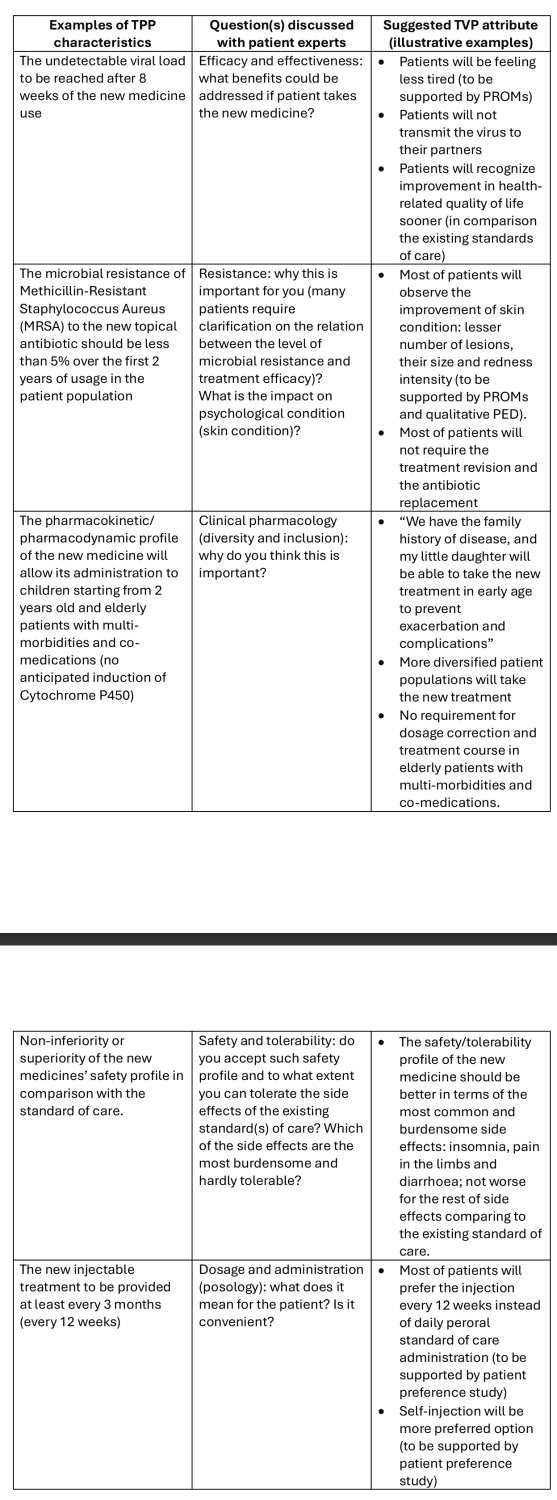
The suggested TVP attributes allow to revisit TPP characteristics drafted earlier, make necessary amendments and therefore upgrade the asset development strategy driven by PED and value-driven insights. Additionally, the agreed TVP attributes such as effectiveness/efficacy and safety/tolerability can create a foundation for benefit/risk profile, which should be discussed and assessed by patient experts earlier rather than later.
So, let’s conclude:
1. Long-term, trusted partnership with patient community and patient experts should be set as early as possible within the research and early development stages – to support target identification and validation, then inform the target profiles.
2. TPP characteristics are only instrumental for research teams and usually don’t explain the real value to be delivered to patient by an innovative product. They must be translated to the “value” language and discussed holistically with patient experts.
3. Suggested and agreed TVP attributes come back to TPP characteristics to amend and upgrade them substantiating an asset development strategy.
4. PED generation, analysis and patient journey mapping are MUST-steps to support early research and development as well as entire asset development continuum; this is NOT anymore “nice to have” evidence generation exercise to support later stages, launch excellence and submissions.
If your company or early research foundation has no idea on how to establish long-term, trusted partnership with patient communities, engage with patient experts to inform TPP/TVP and asset development strategy, what to ask them and how to facilitate such discussions and advisory panels, don’t hesitate to contact me – I will be happy to help!